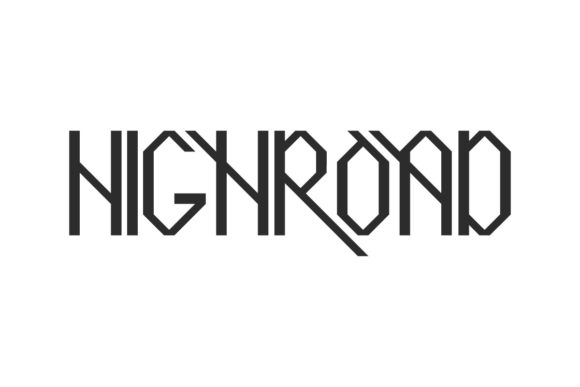
Highroad: A Bold Geometric Display Font for High-Impact Design
In the landscape of digital typography, finding a typeface that commands attention without sacrificing legibility is a persistent challenge. Many designers gravitate toward trendy, overly stylized fonts that look striking in isolation but fail to perform in real-world applications. Highroad emerges as a distinct alternative in this crowded market. It is a cool, bold, and geometrically styled display font designed specifically for projects that require immediate visual impact. Unlike standard text faces meant for paragraphs, Highroad is engineered for headlines, logos, posters, and branding elements where character and presence are paramount.
Understanding the specific utility of a display font requires looking beyond its aesthetic appeal. We must evaluate its structural integrity, encoding efficiency, and versatility across different media. For professionals ranging from freelance graphic designers to marketing directors, the choice of typography directly influences brand perception. Highroad offers a unique combination of modern geometric precision and decorative flair, making it a compelling asset for those seeking to elevate their visual communication.
Defining the Visual Identity of Highroad
The core identity of Highroad is rooted in geometry. The letterforms are constructed with clean lines, sharp angles, and uniform stroke weights that reflect a contemporary, minimalist sensibility. This geometric foundation provides a sense of stability and order, which is often associated with modern technology, architecture, and forward-thinking brands. However, what distinguishes Highroad from other geometric sans-serifs is its "cool" attitude—a subtle edge provided by its specific proportions and terminal cuts.
The font’s bold weight is not merely an increased thickness; it is a deliberate design choice that ensures readability at large sizes. When used for headers or signage, Highroad maintains its shape without becoming muddy or indistinct. This makes it particularly effective for digital interfaces where screen resolution can sometimes soften fine details. The geometric nature of the letters also lends itself well to symmetry, allowing for balanced compositions in logo design and editorial layouts.
Furthermore, the term "display font" indicates its primary use case. Highroad is not intended for long-form body text. Its high contrast and distinctive shapes are best appreciated when viewed in short bursts—titles, quotes, product names, and call-to-action buttons. Recognizing this limitation is crucial for proper application. Misusing a display font for paragraphs results in visual fatigue and poor user experience. Highroad shines when given space to breathe, allowing its geometric structure to define the hierarchy of information.
Technical Advantages: PUA Encoding and Glyph Access
One of the most significant practical advantages of Highroad is its technical implementation, specifically its use of PUA (Private Use Area) encoding. To understand why this matters, one must look at how fonts handle special characters. Traditional fonts often limit swashes, ligatures, and alternate glyphs to standard Unicode positions, which can cause compatibility issues across different software platforms and operating systems. PUA encoding places these additional characters in a reserved section of the Unicode standard that does not conflict with standard text characters.
This encoding method allows designers to access all of the glyphs and swashes with ease. Instead of hunting through complex OpenType feature menus or dealing with inconsistent rendering, users can insert special characters directly. This streamlines the workflow significantly, especially for projects that require rapid iteration or frequent updates. For agencies working under tight deadlines, the ability to quickly toggle between standard letters and decorative swashes without breaking layout consistency is a substantial time-saver.
Additionally, PUA encoding ensures broader compatibility. Since these characters do not interfere with standard text input, they are less likely to be stripped out or corrupted when files are shared between different design tools or uploaded to various content management systems. This reliability is essential for cross-platform projects, such as responsive websites that need to maintain their typographic integrity on mobile devices, tablets, and desktop screens alike.
Practical Applications and Industry Fit
The versatility of Highroad makes it suitable for a wide range of industries. Its bold, geometric aesthetic aligns naturally with sectors that value innovation, clarity, and strength. Here are several contexts where Highroad demonstrates particular effectiveness:
- Brand Identity and Logos: The strong, block-like structures of Highroad provide a solid foundation for logo marks. Its geometric purity allows for easy adaptation into monograms or abstract symbols, ensuring that the brand remains recognizable even at small sizes.
- Digital Marketing and Social Media: In the fast-scrolling environment of social media feeds, typography must grab attention instantly. Highroad’s bold weight and unique style help posts stand out in crowded timelines. It is ideal for quote graphics, event announcements, and promotional banners.
- Event Posters and Flyers: For conferences, concerts, or product launches, Highroad delivers the energy and excitement required to attract attendees. Its dynamic feel adds a layer of sophistication that generic fonts often lack.
- E-commerce and Product Packaging: On packaging, shelf presence is critical. Highroad’s clarity ensures that product names are easily readable from a distance, while its stylish appearance elevates the perceived value of the item.
Freelancers and small business owners will find Highroad particularly useful because it bridges the gap between professional polish and creative expression. It allows non-designers to create visually appealing materials without needing advanced typographic knowledge. By simply selecting Highroad for headlines, they can achieve a cohesive and modern look that competes with designs produced by seasoned professionals.
Evaluating Usability and Workflow Integration
When integrating a new font into a workflow, usability is just as important as aesthetics. Highroad scores highly in this regard due to its straightforward installation and intuitive usage. The PUA encoding reduces the learning curve, as users do not need to master complex keyboard shortcuts or specialized software features to access the full character set. This accessibility lowers the barrier to entry for hobbyists and beginners who may feel intimidated by more complex type systems.
However, users should remain mindful of file size and performance. While Highroad is efficient, the inclusion of numerous swashes and alternates can increase the overall file size compared to a basic sans-serif. For web projects, this means optimizing font loading strategies to ensure fast page speeds. Subsetting the font to include only the necessary characters can mitigate this issue, preserving performance without sacrificing design quality.
Consistency is another key factor. Highroad maintains its stylistic voice across different weights and styles, if available. This consistency helps in creating unified design systems where headings, subheadings, and labels share a common visual language. Designers can mix Highroad with simpler, neutral sans-serifs for body text to create a pleasing contrast between the bold display elements and the readable informational content.
Potential Limitations and Considerations
No typeface is perfect for every situation, and Highroad is no exception. Its bold, geometric nature can become overwhelming if overused. Pairing multiple geometric display fonts together often results in visual clutter and competition for attention. It is advisable to use Highroad as a singular focal point within a design, supporting it with more subdued typography for secondary information.
Additionally, the cool, detached aesthetic of Highroad may not suit brands seeking warmth, tradition, or approachability. Industries such as hospitality, childcare, or artisanal crafts might find Highroad too rigid or impersonal. In such cases, a serif font or a rounded sans-serif would likely better convey the desired emotional tone. Understanding the psychological impact of typography is essential for making informed decisions.
Finally, while PUA encoding offers flexibility, it can sometimes pose challenges in legacy systems or older publishing software that do not fully support Private Use Area characters. Before committing to Highroad for a print-heavy project, it is prudent to test the font in the specific production environment to ensure seamless output.
Conclusion: Is Highroad Right for Your Project?
Highroad represents a thoughtful addition to the toolkit of any designer or creator looking to make a strong visual statement. Its blend of geometric precision, bold presence, and technical convenience via PUA encoding makes it a robust choice for modern design needs. Whether you are crafting a brand identity, designing a digital campaign, or producing printed materials, Highroad offers the reliability and style necessary to engage audiences effectively.
For professionals who prioritize efficiency and impact, Highroad delivers on both fronts. It simplifies the process of accessing decorative elements while maintaining a sleek, contemporary appearance. By understanding its strengths and limitations, users can leverage Highroad to enhance their projects with confidence. In a world saturated with visual noise, choosing a typeface that communicates clearly and boldly is a strategic advantage. Highroad provides exactly that, proving that good design is not just about looking good, but about functioning well within the constraints of real-world application.